*Note for students: This is from old study material*
1. Meaning of Politics: Theorizing the 'Political'
Politics is used as the science and art of Government; it deals with the issue of public affairs and governance.
Two words used in correlation with 'politics', and instrumental in shaping its meaning, are government and public affairs. The two are themselves related, because the government has to deal with the public affairs.
This understanding is a very broad notion; it does not give a concrete and compartmentalized understanding of the word politics.
Politics has been widely discussed and debated, and a common understanding of 'What is Politics?' has not been agreed upon.
Even so, every individual understands the realm of politics in some way: one cannot be devoid of an opinion on what politics actually is.
Opinions can be diverse and often at loggerheads, but by the essence of being human, one is bound to think about politics.
The expanse of politics is wide. It ranges from one's existence, to one's nature as a human, a social being and a political creature, and goes beyond existence to one's social and political identity.
The word politics comes from Aristotle's classic work 'Politika', meaning 'affairs of the cities'.
2. Key Definitions of Politics
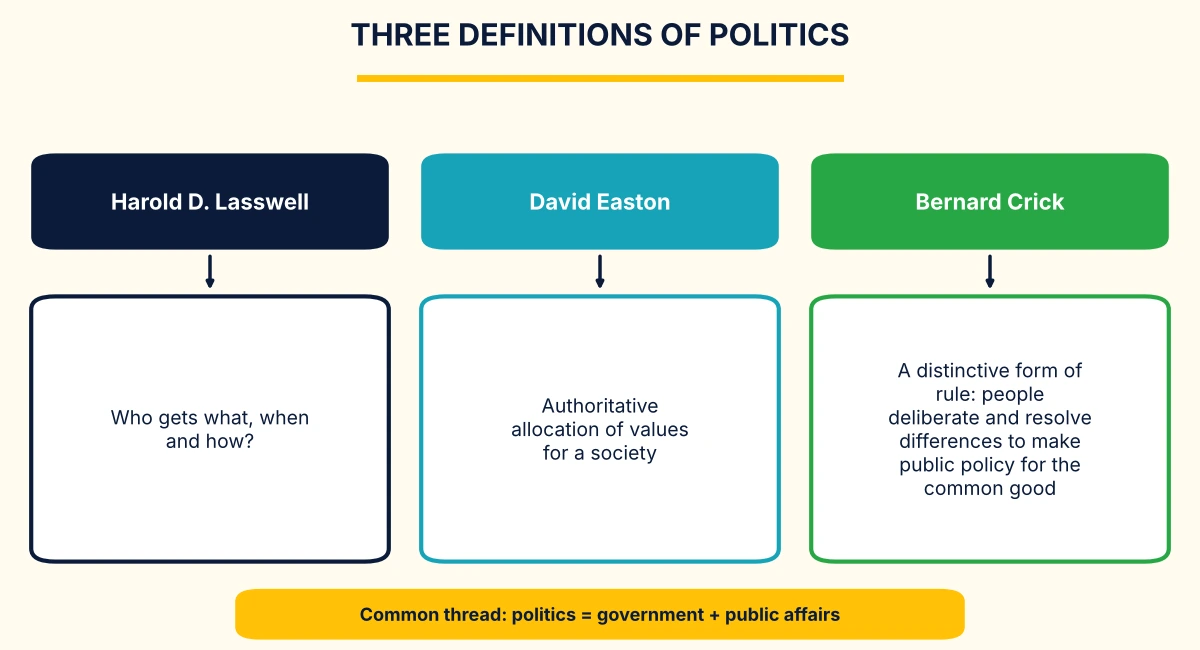
FIG: Three definitions of politicsDefinitions by scholars
Harold D. Lasswell defines politics as "Who gets what, when and how?"
His idea advocates the rights of citizens and the institutional procedure of the state in granting the rights of the people.
David Easton describes politics as the "authoritative allocation of values for a society".
His conception of values talks about a set of values broadly agreed upon by the state to adhere to.
The idea of core values that guide the state is inherent in the idea of politics.
A value can be anything valued by the society: an ideology, goal, social ranking or any core essence deemed the benchmark for carrying out governance.
The term value is a dependent variable and can be allocated a character as per requirements, demand or preferences.
Bernard Crick (In Defence of Politics, 1962) defines politics as a distinctive form of rule where people come together through an institutional mechanism to deliberate and resolve differences and articulate public policy for the common good.
Crick lays emphasis on reconciliation, bargaining and shared understanding.
The culmination of this understanding is manifested in the policies formulated by the State.
Politics between State and Society
Politics comes across as an idea that falls within the juxtaposition of state and society.
The state often resonates with the government, and society with the group of individuals.
The two are linked by the idea of governance, which in turn is linked by the aspects of politics.
However, the idea of politics disintegrates the basic concept of State and Society. The cardinal distinction between the two is usually overlooked, and it draws attention to the relationship between the two, which underlines the realm of the political.
As per this distinction, intra-state affairs fall under the ambit of politics. But intra-societal affairs concerned with the sanction of reallocation and legitimation of power are extraneous to the idea of politics.
The null hypothesis
'What is Politics' is often defined by a null hypothesis: it is the absence of a variable that validates the presence of politics.
That variable is 'social'.
3. The Political vs the Social: Citizenship vs Membership
Politics vs the Political vs the Social
The variable whose absence validates the presence of politics is 'social'. Before examining the interdependency of the two, ask: what is political? Is it different from Politics?
The word politics comes from Aristotle's classic work 'Politika', meaning 'affairs of the cities'.
Political is the nature that politics imparts; it is the characterization that comes from the virtue of politics.
Politics can be defined as a static term, but political is dynamic and reinventing, because it imparts attributes and characteristics to an individual and an institution.
Over the years, the way society has been perceived and understood has often tried to envelop the social into the political.
Social comes from the Latin word 'socius', meaning friend.
The perception of social lies in being amicable, empathetic and enduring.
It has the virtue of coexistence and is about people coming together.
Aristotle's idea of man as a social being rests on the social nature of the individual as a cooperative entity who has shared purposes and meanings of existence.
The identity of a human does not arise from the state but from the virtue of being a social entity.
Political institutions, their attributes and functions are inherently social in tendency. However, the claim is that the political is not social.
Key questions at the helm of understanding what is essentially political:
Can the political have certain attributes of the social?
If it has characteristic features of the social, does it become social?
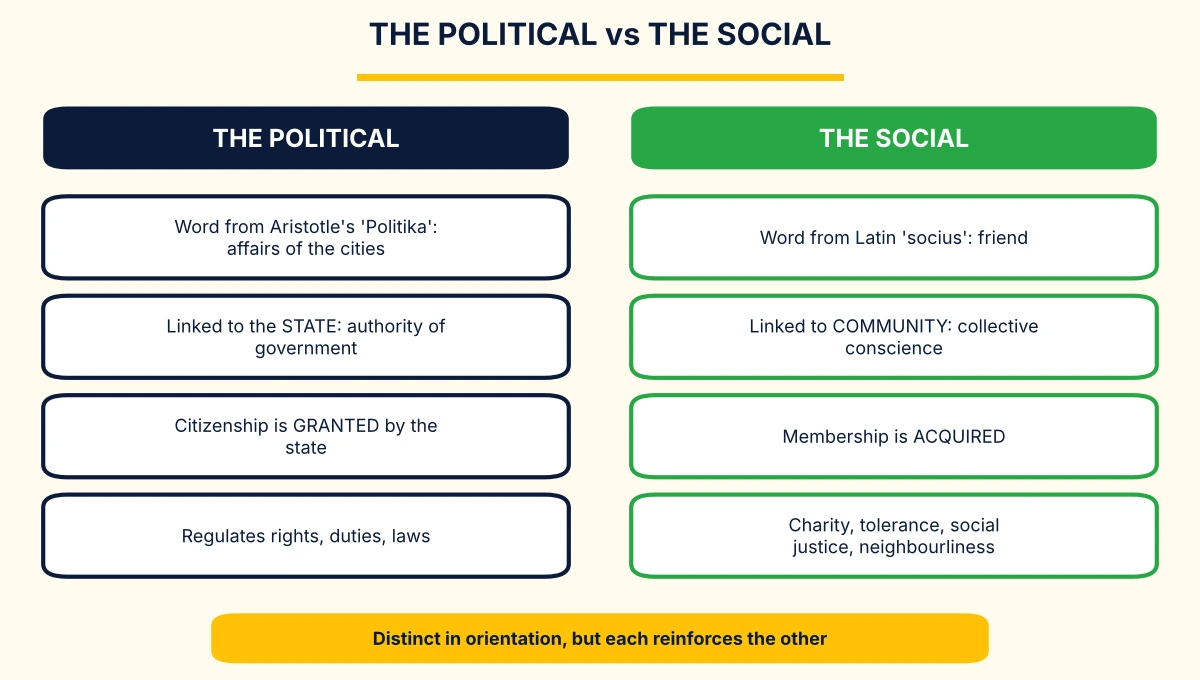
Citizenship vs Membership
Does citizenship confer identity on the members of the state? Do membership and citizenship differ in orientation?
The basic rights of an individual as a citizen are enshrined in the constitution, whereas the interpersonal approach of an individual emanates from the consciousness of being a social being.
The attributes of social membership are distinct from the rights an individual imbibes as a citizen of the state.
A citizen is a member of a community but a citizen of the state.
Membership is acquired whereas citizenship is granted. An external authority grants the sanctity of citizenship.
The state regulates citizenship, but the community is what one is a member of.
Community = a collective conscience;
state = an authoritative position.
Social acts and the good human
Examples of social contribution:
Charity, donations or any other form of physical help for the well-being of society.
Nurturing a peaceful, habitable and tolerant society by assimilating people of various caste, colour and culture.
Maintaining amicable relations by respecting one's neighbour and pursuing social justice.
Spreading environmental awareness and nurturing an eco-friendly and sustainable way of life.
These come by the virtue of being a good human, not by the identity of being a law-abiding citizen.
A citizen can adhere to duties enshrined by the state and avail rights, but citizenship is not a precondition for contributing to the social enrichment of a group of people.
Aristotle's State: not every section of society was a citizen, but everyone imbibed a sense of belonging to the land they inhabited.
Nation vs State
The discourse on nationalism has blurred the boundaries between social and political; the discourse of Nation and State is itself a question of social and political.
Nation is the feeling of belongingness. It has the element of race, religion, ethnicity, caste and involves the submerging of identities in a unanimous umbrella of Nation.
State is the territorial boundary bound by an authority of Government.
Nationalism takes the orientation of a state towards that of a community, where individuals are united by a bond of togetherness and a sense of belongingness to a common set of beliefs and ideas.
Etzioni (2003): the more the state expands its functions and takes over the attributes of a voluntary association like a community or a family, the weaker the society will become.
The difference between citizenship and membership can be realised by drawing an analogy between the state-society and state-individual relationships.
Social welfare and Crick
The difference between social and political, if built upon, leads to a larger dialogue in society, culminating into social welfare policies.
These are public policies that go beyond administrative concerns and provide a safety-net to the people, being a benefactor of the marginalized, downtrodden and weaker sections of society.
This idea of reaggregation and convergence of interest of individuals was brought forth by Bernard Crick in his famous work In Defence of Politics.
The idea of policy making actualizes the politics of the state. Assimilating the social context into the political underpinning, resulting in public policy, is the premise on which Crick built his idea of politics.
The demarcation between social and political also indicates a line where the distinction between the two is transgressed.
Conclusion: the political and the social are distinct in orientation and approach, but are reinstating conditions for each other.
4. The Conception of Moral: Social Conservatives vs Communitarians
Moral rests on the conception of 'good'. The idea of good is subjective, but in the moral paradigm there is only a universal good that forms the base of morality.
The acceptance that comes with the good is the idea of morality that the state and society practice.
Key question: if there is no subjective good in morality, can the state and society be good at the same time, or do they differ in their orientation of good?
Social Conservatives
It is the prerogative of the state to go beyond the idea of citizenship and inculcate social virtues to make a good society.
The state has the potential to regulate human behaviour and bring a moderation in the attributes of an individual.
People are self-indulgent by nature, tend to exploit their liberty and become insensitive to the needs of others.
Hence social conservatives endorse the need for a 'strong national government' that will mould the attributes of an individual and counterbalance the weaker aspects of citizens (Brooks/Kristal, 1997).
Virtuous behaviour comes to be shaped by the state in the conservative discourse.
The dilemma lies between a good law-abiding citizen and a good person in general. The idea of a 'good state' does not focus on containing the state to undermine individual liberty.
Communitarians
Communitarians perceive society as the agency that promotes moral behaviour.
Morally good conduct goes beyond the permissibility of an agency into the personal realm; it transcends the apparatus of the state.
It moves beyond the fiduciary relationship of state and citizens to a relationship of trust, harmony and camaraderie between the members.
It is a just and equitable society where not the state but the citizens extend a hand to the weak, vulnerable and deprived sections.
The good society reaches the private realm but with only a limited set of core values.
It is not as expansive and holistic as in a liberal state or a government-centred society; the scope of good is limited and particular.
The formulations of good may differ in the outlook of the political and the society. If they are contested, how is the gap counterbalanced to maintain an unequivocal idea of good?
5. Is Politics Moral? The Liberal and Communitarian View
Every political action has a moral underpinning; there are no political deliberations devoid of a moral pretext.
'Moral' here relates to a broad range of moral social values imbibed in the normative considerations of justice and equality, not a limited and personal understanding of morality.
The Liberal view
Liberals hold that the ambit of morality should not pervade the public and political realm; moral deliberations are confined to the private realm.
They fear that the intrusion of morality in the public domain can trigger a cultural war.
The public arena falls in the ambit of the State, where the orientation of the state and the idea of politics should remain neutral.
Endorsing morality in the public forum is likely to be perceived as coercion and propagation of shared values.
The extent of the state's 'neutrality' and 'autonomy' differs among liberals:
One section believes individual virtues like critical thinking uphold the merit of the state (Gutmann, 1987).
Another follows Isaiah Berlin: a limited set of values, deliberated, discussed and agreed upon in the public forum, forms the morality the state professes and propagates.
Example: stealing, rape and murder are reprimanded in any society.
Disagreement and public policy
The nature of punishment differs in acceptance by a particular society: a state can believe in capital punishment or stay neutral about it.
Euthanasia (mercy killing) is another point of contention and differs across states.
LGBT rights are the most contemporary example; different states have a different take on various aspects of the community.
Endorsing different values is not divided into watertight compartments. Subscribing to divergent and irreconcilable values does not lead to a political deadlock.
Public policy is formulated to reconcile differences of opinion and adopt a middle path for optimum suitability.
Communitarians and the role of law
Communitarians argue that politics should rearticulate shared values and the understanding of morality.
Contemporary politics of free and democratic societies rests on the pillar of demand aggregation and articulation.
The absence of broad consensus on values, beliefs and demands leads to turmoil and discontent, as visible between Jewish and Arabic citizens of Israel.
Consensus between communities plays a vital role in maintaining the peace and sanctity of a democracy. Conflict arises from differences of opinion and lack of consensus in governing groups defined by caste, class, region and language.
The law acts as a neutral arbiter and the conscience of the state apparatus by upholding the essence of morality.
Law can never be morally neutral, but it has to be unbiased and wise in adjudicating matters of the state, and neutral in its preferences and affiliations.
It does not impose the will of the majority on the populace but upholds the prerogative for a just and equitable society.
6. The Political and the State: Locke, Mill and Tocqueville on Morality
Two conceptions of morality?
Key questions: are there two conceptions of morality, one for society and one for the state? If different, do they ever converge? What are the repercussions? Which notion does the citizen abide by? Are there major differences between a 'good society' and a 'good state'?
A good society harbours a moral voice: individuals have a sense of morality and behave in a pro-social manner.
The pro-social sense can be innate (arising from the virtue of being human) or acquired.
The role of parenting and education is pivotal in shaping the moral attributes of an individual.
Communitarians emphasize that morality needs to be reinforced, which comes from the environment in which an individual thrives.
The approval of people one holds in great regard matters, so the community not only harbours but also instils a value system.
The significant role is played not only by how values are enforced but by how they are fostered.
John Locke
Man is a rational being who can apply deductive reasoning and determine the sense of morality granted by God.
Locke's moral rationalism is based on the empirical understanding of ideas: the human mind is a tabula rasa, and the sensory understanding builds up the idea of morality.
We construct complex moral propositions from the simple perceptions we imbibe through sensory and reflexive experiences.
Locke knit an interrelation between reason and morality.
The state of nature was pre-political but not pre-moral: a sense of morality already existed, so a political state needs a basic conception of morality.
Individual, society and state: Mill and Tocqueville
The point of intervention is to assess whether there is a difference in what society, the state and the individual consider as morality.
There is a contention between compliance with the moral voice and what an individual truly wants by virtue of his freedom and entitlement.
John Stuart Mill (On Liberty): if an individual deserves to be free from state control, does he not deserve to be free from social pressure that emanates from the societal morality?
The dealings of society with the individual can be understood as compulsion and control, either through physical punishment or the moral coercion that the state asserts.
The morality the state endorses can differ for various sections; it can manifest as the popular will or the dominant public opinion.
Tocqueville (1991): the multitude of numbers in a democracy has the power to coerce by the will of the majority; public disapprobation leads to alienation and despair of people whose demands have not been assimilated.
The distinction lies in the force of coercion: a state can be morally coercive, but a community endorses an internal moral voice that is not to be feared but inculcated.
Internal vs external moral choice
Internal moral choice is part of one's existence, borne from the roots of one's being; it shapes moral character and resonates with individual liberty and free choice.
External moral choice is community-driven, imbibed from the societal construct of 'good' and 'bad'. It lays the onus on the individual to select or reject the moral construct advocated.
The final call is with the individual. Society has the tendency to cajole, persuade and censure, but it is up to the individual to adhere.
The state and coercion
When the state undertakes the responsibility of morality, it has the force of coercion because of the sanction of legality.
The state may use non-coercive tools to persuade and educate the masses through institutional mechanisms, but the actor has no choice but to comply, being a law-abiding citizen. The last recourse of the state can be force to command allegiance.
Is the moral voice coercive, or the agency enforcing the voice? The moral voice is not coercive by virtue; enforcement can be, because of the legal and economic sanctions attached to it.
It is not the morality but the agency endorsing it that is coercive.
Liberal democracy and the voluntary moral voice
A contemporary liberal democratic set-up offers liberty and freedom to manoeuvre. An individual has the liberty to choose and reside in a state he aspires to, and the reasoning and moral voice to submit to a state authority he feels entrusted to.
Adhering to societal pressure also emanates from the individual's moral understanding: his actions are socially, culturally and morally placed because he is part of a society and a state and owes allegiance to at least a limited set of people.
Example: parents taking care of their children is led not by moral coercion by the state but by the moral voice that the community propagates. Elderly parents being abandoned by their children is a question of moral voice and personal choice.
The voluntaristic nature of the moral voice paves the way to reconcile a good society with liberty; this idea should form the core of the liberal state and society.
Social institutions
Social institutions play a pivotal role in characterizing the difference between a good society and the good promoted by the state.
Institutions are not value-neutral; they are the embodiment of a particular set of people. The family, a primary social institution, is an evident example of a value-laden entity.
A prominent understanding correlates the freedom of the institution with the quotient of morality it imbibes and prophesies.
Politicised institutions are instruments for serving the state-promoted notion of good.
7. Deliberation, Public Policy and Law
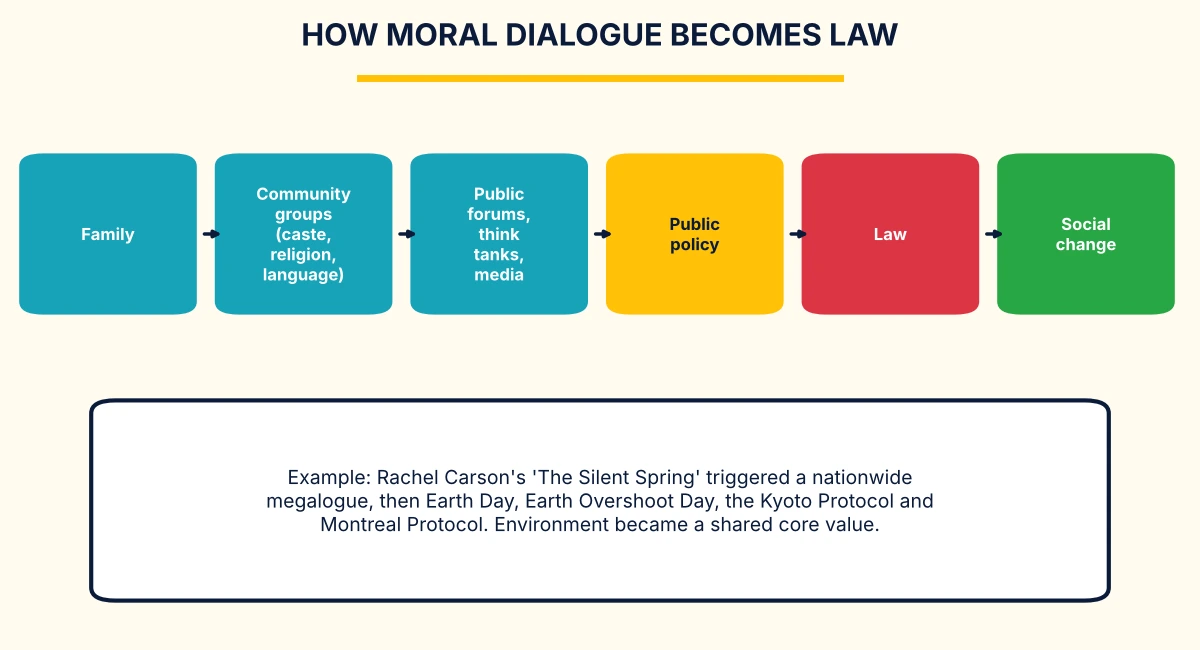
Deliberation and public policy
The outcome of deliberations is manifested in public policy. Policies voice the concerns of society and the outlook of the state in promoting the general well-being of the people.
Policies are deemed the rational choice of policy makers to voice citizens' concerns in the public forum, and a reasoned outcome for resolving political conflict (Knight & Johnson, 1994).
Deliberations and democracy walk hand in hand and are vital for upholding the moral conscience of the state.
Moral dialogues engage the values of the participants and deduce a rational and logical discourse for shaping a due course of action.
The entire process is substantive and not merely procedural.
Values are not stagnant; they are reorienting and adapting with time.
A shared consensus is reached for adjudicating the law and order of the state, and is transformed into policies that form part of governance.
Moral dialogues can pertain to human rights, gender rights, sexual harassment and other important discourses in democracy.
The chain of deliberation
Dialogues occur at a preliminary level in the family, and then at the level of the community. How a society renegotiates a renewed set of values determines the openness of the society.
Deliberations occur in a chain reaction and can lead to a change in the perception of values. They start in small groups across millions of people, such as a family, caste, religion, common ethnicity or common language.
The process is carried forward by interlinking of such groups, which transform into shared public forums and think tanks, and then a wide net of meetings at regional and national levels.
The world is knit by digital infrastructure, so agendas of discussion are digitally curated. Media has been instrumental in voicing opinion and discovering voices across sections of society.
Dialogues need not be orderly or focused on a particular change; they need no clear pattern or beginning. They only need a dialogue to trigger a discourse.
Example: environmental awareness
Environmental concern was not part of the mainstream discourse. Individuals, groups and communities raised underlying issues, but it was not a shared core value in Western societies.
Rachel Carson's famous work The Silent Spring triggered a nationwide megalogue. It was talked about at various forums, upheld by citizens as a prime cause of concern, and included in the normative agenda.
From the proclamation of Earth Day and the observation of Earth Overshoot Day to protocols and conventions like the Kyoto Protocol and the Montreal Protocol, environmental degradation and the control of greenhouse gas emissions have become an utmost concern across countries.
Countries often do not reach a standard conclusion and differ on the measures to be taken, but the differences do not alter the view that environmental concerns are now a shared core value to be included in policy making.
It is not just legislative bodies that form part of the dialogue on established core values; it is a distinct social process nurtured in the social realm, with a deep implication on the political discourse of the state.
Law as the outcome
Law is the catalyst in achieving societal change and a core outcome of political processes.
Moral dialogues take place in the political realm but do not mature in the same: society nurtures the dialogue and the law helps achieve the outcome. The law of the land leads social change.
The nature of morality defines a good society, and the law must be in accordance with the moral culture. Otherwise, the nature of the state may turn authoritarian, or in the worst form totalitarian.
Law is the first step for ensuring social change and preserving the order of the state. It also needs the will and force of the moral voice to be enforced.
Coercion alone cannot prohibit an immoral act. The inner moral conscience acts as a guiding star in directing an individual's action.
Prohibition can regulate moral behaviour but not imbibe moral etiquettes in individuals.
Example: corruption in the bureaucratic order can be prohibited and regulated, but it is the inner conscience or moral voice that makes society free of corruption.
Fear can command and not demand morality; the force of the moral voice must be reckoned with even in adhering to the law of the land.
8. Conclusion (Quick Revision)
The political and the moral, though cardinally different, are interlinked in myriad ways. They cannot be confused as the same, nor compartmentalised for understanding them individually.
A free democratic liberal order governs by the sanctity of law, and the law is reinforced by the State apparatus.
The political governs by a shared understanding of morality. The state is a part of the political, and its actions have a moral dimension because they operate on a shared understanding and broad consensus of values.
The contemporary political understanding is a reinstatement of morality writ large in the form of social consensus.
The idea of state vs community is now visualised as a political community, because the interdependence of nations has enlarged shared understanding to a more holistic, comprehensive and cohesive understanding of governance.
Governance also has a paradigm of social governance; the actions of the State are to be understood in nexus with each other rather than in isolation.
The outcome of moral dialogues has matured, and the idea of shared values has reinvented itself to be more conclusive in its approach.
The sanctity of the state emanates from the people, because the people authorise the state to govern. The people are guided by a moral voice, so the power of moral deliberations reflects at the level of Government as well.
What is political never has a compartmentalised understanding, because politics is the sum total of attributes of social, economic and moral virtues that guides the governance of the State.
Key terms at a glance
| Term | Meaning |
Politics | Science and art of Government; deals with public affairs and governance |
Political | The dynamic nature that politics imparts to individuals and institutions |
Social | From Latin 'socius' (friend); amicable, cooperative, about coexistence |
Citizenship | Granted by the state, an external authority |
Membership | Acquired by belonging to a community |
Easton's values | Anything society prizes (ideology, goal, social ranking) that guides governance |
Public policy | Reasoned outcome of deliberation for resolving political conflict |
Moral voice | Voluntary inner conscience; coercive only when an agency enforces it |
Law | Catalyst of social change; must match the moral culture |
9. Important Exam Questions
Note on sources: Q1 is answered from Unit 1. Unit 1 does not define political theory, so Q2 and Q3 also use the PDF's own Unit 2 (Mitalee Mahapatra, Approaches to Political Theory).
Answer
What is Politics?
Politics is the science and art of Government; it deals with public affairs and governance.
There is no agreed definition, but scholars have defined it:
Lasswell: "Who gets what, when and how?", pointing to citizens' rights and the state's institutional procedure in granting them.
Easton: the "authoritative allocation of values for a society"; values are the core things society prizes, which guide governance.
Crick: a distinctive form of rule where people deliberate and resolve differences through institutions to frame public policy for the common good.
Politics lies between the state (government) and society (group of individuals), linked by governance.
It is defined by a null hypothesis: the absence of the 'social' validates the presence of politics. The political is not social, yet the two reinstate each other.
The political is also moral: every political action has a moral underpinning, and the political is tied to the state, which enforces law.
Why do we study it?
Every human is a social and political being and is bound to hold an opinion on politics, so a clear understanding is needed.
It explains how rights, citizenship and institutional procedure work: who gets what, when and how.
It shows how values, deliberation and public policy turn society's concerns into law and social change, as in the environmental movement after The Silent Spring.
It clarifies the boundaries between state and society, citizenship and membership, law and moral voice, and shows why state power needs consensus to stay legitimate.
It explains that the sanctity of the state comes from the people, who authorise it to govern.
Answer
What is Politics? As in Q1: the science and art of government dealing with public affairs, defined by Lasswell, Easton and Crick, and understood as the space between state and society.
Connotations of political theory (Unit 2 of the PDF):
Independent domain: political theory is an independent domain within Political Science; it is one of its core disciplines and has gained independent recognition as an academic subject.
Understanding the political order: it is an attempt to understand what the political order is; a formal, logical and systematic study of political activity and its consequences.
Description and explanation: it combines description and explanation, and tries to give political things order, consistency and significance.
Critical outlook: it is the intellectual tradition that sees beyond immediate practical concerns and 'watches' man's societal life critically.
Ethical benchmark: it deals with political phenomena, processes, institutions and behaviour by subjecting them to a philosophical or ethical benchmark, and asks about the best political order within the larger question of the ideal form of life a human being should lead in a community.
Theoretical statements about the nature of politics matter more to political theorists than empirical claims.
Sabine's view: it is man's attempt to consciously understand and solve the problems of his group life; by showing what a practice means or ought to mean, it can alter what it is.
Distinctions:
Political Science is founded on empiricism: it describes and explains institutions and government in an impartial, value-free manner.
Political Philosophy is the philosophical reflection on how to arrange political institutions and social practices, viewing concepts through ethics.
According to empirically guided political scientists, political theory is value-neutral, rational and objective, while political philosophy relies on customs, traditions and values.
Approaches: broadly Traditional (dominant till World War II) and Modern (contemporary, pragmatic); Unit 2 covers the normative, historical and empirical approaches.
Answer
What is political theory?
A formal, logical and systematic study of political activity and its consequences; an independent domain within Political Science.
It tries to understand what the political order is and to give political things order, consistency and significance.
It combines description and explanation, and looks critically at group life and organization (Sabine).
Relevance of political theory
It helps one understand critical concepts like State, Society and Values (Unit 2).
It shows not only what a political practice is but what it means or ought to mean, so it can alter what it is (Sabine, Unit 2).
It raises the question of the best political order and the ideal form of life in a community (Unit 2).
It provides conceptual clarity on questions such as what is political, how it differs from the social and the moral, and how policy and law arise from deliberation, as Unit 1 shows. (Unit 1 link)
It encourages critical, reasoned thinking about public affairs rather than accepting practices as given. (Unit 1 link)